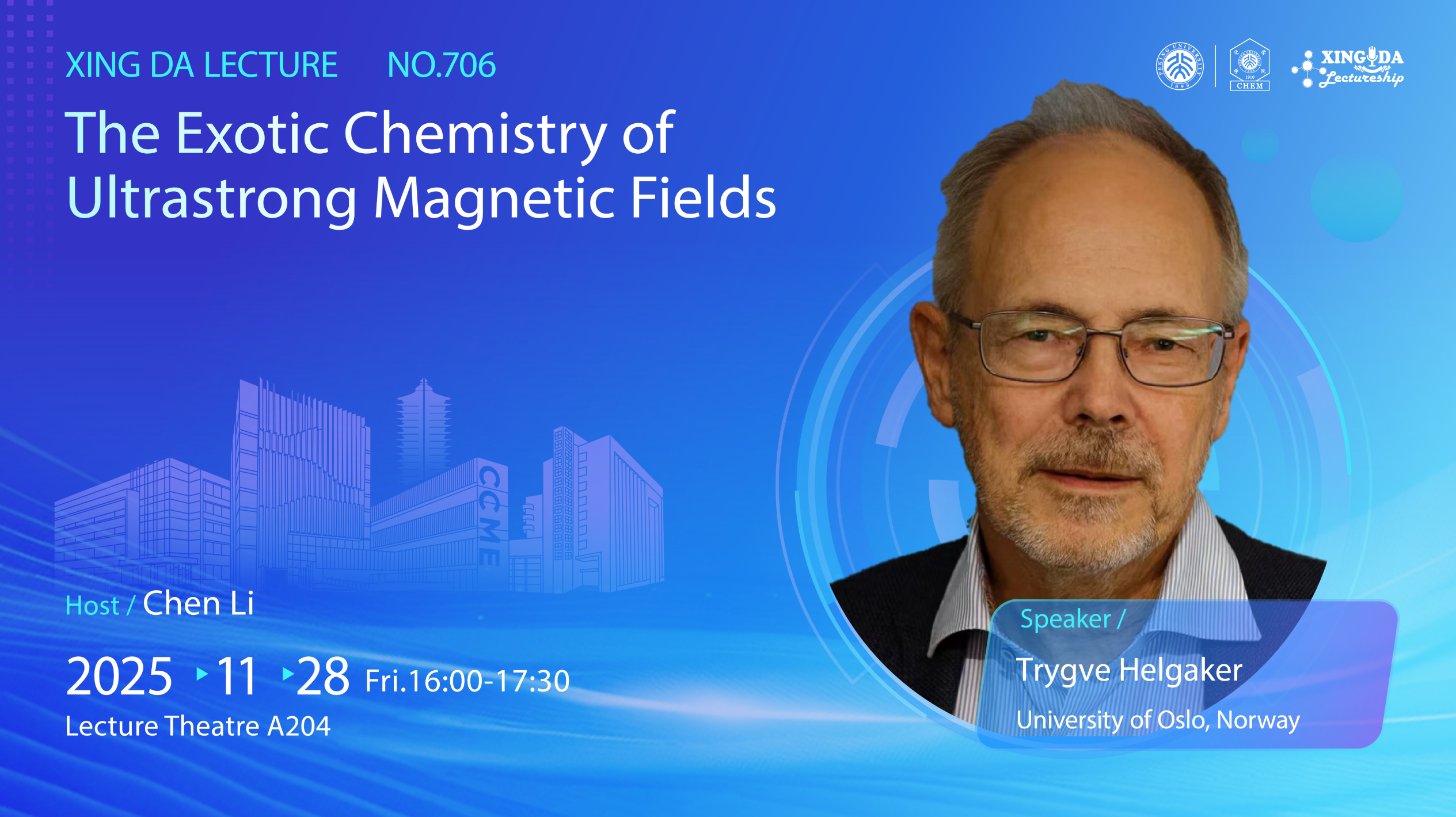
Abstract
In ultrastrong magnetic fields—around 100 kT—the magnetic forces acting on electrons become as important as the Coulomb forces that normally shape atoms and molecules. Under such extreme conditions, the familiar rules of chemistry are dramatically rewritten. Molecules are squeezed and twisted into unfamiliar forms. Ordinary covalent bonds can be torn apart by the spin–Zeeman interaction, while new types of paramagnetic bonds emerge when the orbital–Zeeman effect stabilizes orbitals that are usually antibonding. This gives rise to exotic species such as helium flakes—molecules that cannot exist on Earth but may be stable in the intense magnetic atmospheres of white dwarfs. Even everyday molecules behave differently: methane, normally a pyramidal molecule, becomes perfectly planar.
Molecular motion is also profoundly transformed by strong magnetic fields. In addition to the modified electronic structure, the velocity-dependent Lorentz forces acting on the nuclei change molecular dynamics, with striking consequences for rovibrational spectra in a magnetic field.
Exploring chemistry under such extreme conditions offers a fresh perspective on the familiar chemistry of Earth-like environments. At the same time, it provides a demanding test for quantum-chemical methods originally developed for weak magnetic fields. Density-functional theory, for instance, must be revisited and adapted before it can be used reliably in these strong-field regimes.
Although the main focus of the talk is the structure and dynamics of molecules in ultrastrong magnetic fields, I will also touch on selected aspects of quantum chemistry in magnetic environments.
Biography
Trygve Helgaker, born in 1953, studied chemistry at the University of Oslo from 1975 to 1980. He earned his master's degree, a "cand. scient.," in gas-phase electron diffraction in 1980, under the supervision of Professor Arne Haaland. He also visited the electron-diffraction group at Moscow State University from December 1980 to January 1981.
Helgaker began his doctoral studies in theoretical chemistry in 1981, working with Professor Jan Almlöf at the University of Oslo. He was awarded his Ph.D., a "dr. philos.," in June 1986. Following postdoctoral positions—first at the Institute for Mathematics and its Applications, University of Minnesota, from 1986 to 1987, and then at the Department of Chemistry, Aarhus University, from 1987 to 1989—he became an associate professor ("førsteamanuensis") in Theoretical Chemistry at the University of Oslo in August 1989. Helgaker was promoted to full professor there in 1993 and became a professor emeritus in 2023.
During his career, Helgaker took sabbatical leave with Professor Nicholas Handy at the University of Cambridge from 1999 to 2000, and with Professor David Tozer at Durham University from 2006 to 2007. He has also served as a guest professor at the Laboratoire de Chimie Quantique, Université Louis-Pasteur (ULP), Strasbourg, in January 2003, and at the Laboratorie de Chimie Théoretique, Université Pierre-et-Marie-Curie (UPMC), Paris, in November 2013.
Helgaker has directed two Norwegian Centres of Excellence: the Centre for Theoretical and Computational Chemistry from 2013 to 2017, and the Hylleraas Centre for Quantum Molecular Sciences from 2017 to 2023. In the academic year 2017–2018, he led the project "Molecules in Extreme Environments" at the Centre for Advanced Study (CAS) at the Norwegian Academy of Science and Letters.



 北大化学微信