Abstract
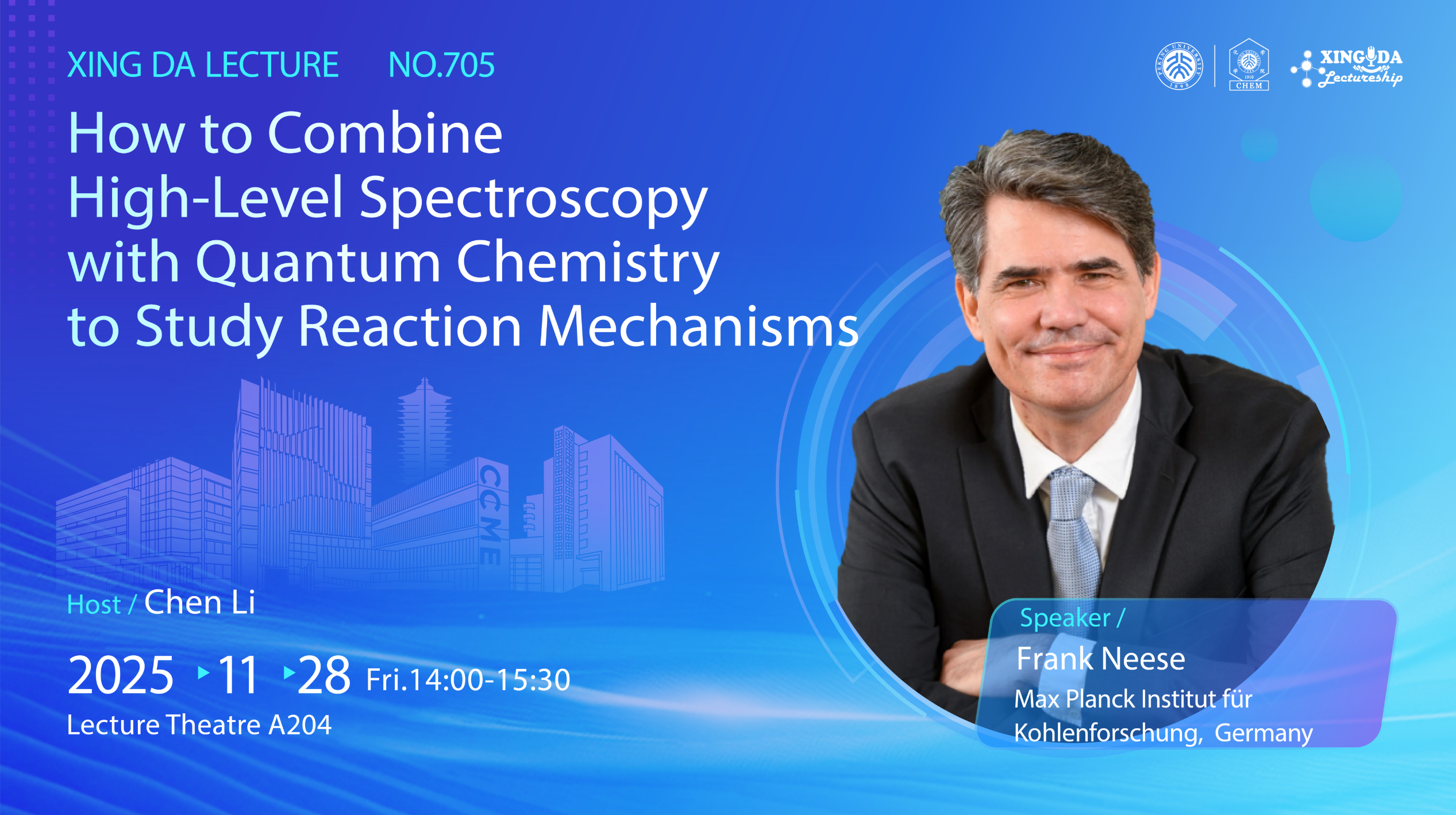
As the use of quantum chemical calculations alongside experimental investigations becomes more and more widespread in chemistry, it is also timely to take a step back and ask the question of “how” exactly, can and should best use calculations in order to be maximally beneficial to chemical research. I will first illustrate my philosophy of approaching the study of chemical mechanisms and the role that spectroscopy and theory can play in it, before turning to recent examples in both, chemistry and biochemistry, that serve to illustrate the abstract concepts.
Biography
Frank Neese received both his Diploma (Biology – 1993) and PH.D (Dr. rer. Nat. – 1997) working (with P. Kroneck) at the University of Konstanz. He performed Postdoctoral work at Stanford University (with E. I. Solomon) from 1997 to 1999, then returned to Konstanz where he completed his Habilitation in 2001.
He joined the Max Planck Institute (MPI) for Bioinorganic Chemistry in 2001 as a group leader, until accepting the position of Chair of Theoretical Chemistry at the University of Bonn in 2006. In 2008, Neese returned part time to the MPI as one of its rare “Max Planck Fellows”. In 2011, he became Director of the MPI for Chemical Energy Conversion where he was leading an interdisciplinary group that combines spectroscopy and theory in development and application. In 2018, Neese was appointed Director of the Max Planck Institut für Kohlenforschung where he heads the department of Molecular Theory and Spectroscopy.
He holds honorary professorships at the Universities of Bonn and Duisburg-Essen. In 2008 Neese received the Klung-Wilhelmy Weberbank award, the highest German prize for young chemists in physicists followed by the Gottfried Wilhelm Leibniz Award of the German Science foundation in 2010.
In addition, He won numerous national and international awards in (bio-)inorganic and theoretical chemistry including the Schrödinger medal of the World Association of Theoretically Oriented Chemists (2022) and the American Chemical Society award in Inorganic Chemistry (2024). Neese is member of various national and international academies including the Northrhine Westfalia Academy of Science (2020), the German National Academy of Sciences (Leopoldina, 2013), The Academia Europaea (2018) and the International Academy of Quantum Molecular Science (2012). Neese served as Editor of the journals PhysChemChemPhys (2011-2014) and Inorganic Chemistry (2015-2022).
In addition, he served on numerous scientific committees including the Central Review panel of the German Science Foundation, the Kuratorium of the German “Fonds der Chemie” and the Fritz-Haber Center in Jerusalem. Neese is the author of more than 700 scientific articles in journals of Chemistry, Biochemistry and Physics. His work focuses on the theory of magnetic spectroscopies (electron paramagnetic resonance, magnetic circular dichroism) and their experimental and theoretical application, local pair natural orbital correlation theories, multi-reference methods, electronic and geometric structure and reactivity of transition metal complexes and metalloenzymes.
Frank Neese is the architect and lead author of the ORCA program, (presently the second most widely used quantum chemistry package worldwide with more than 95000 academic users) as well as co-founder of the company FAccTs (2017) that distributes ORCA commercially to industry.



 北大化学微信